
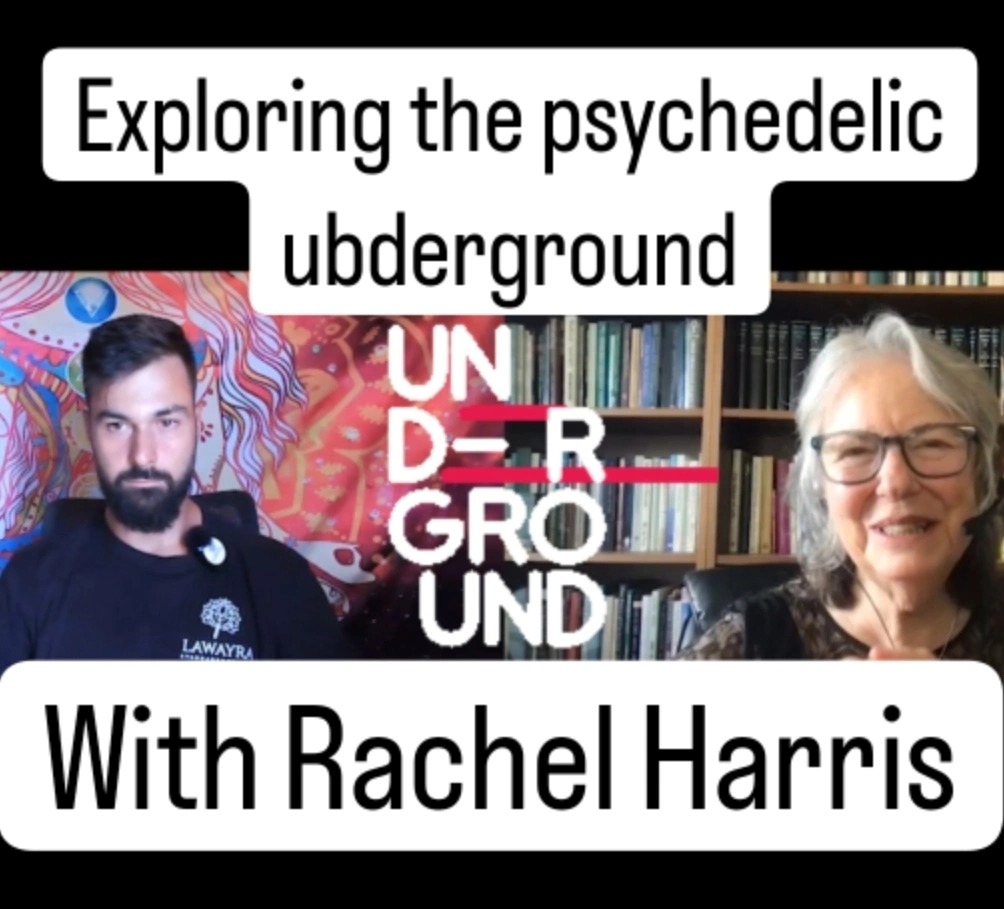
When most people hear the word psychedelic, they imagine ceremonial ayahuasca in the jungle, or psychedelic research conducted in labs and clinics. But there’s another current — less public, less institutional, and sometimes controversial: the psychedelic underground. In a fascinating conversation, host Sam Believ speaks with Rachel Harris, a psychologist, author, and longtime explorer of non-ordinary states of consciousness, about what lies beneath the more visible world of plant medicine and clinical research.
The episode doesn’t sensationalize underground use, nor does it dismiss it. Instead, it offers a nuanced, honest look at why it exists, what people seek there, and what it reveals about human yearning for healing, meaning, and altered states.
What Is the Psychedelic Underground?
Rachel describes the psychedelic underground not as a chaotic free-for-all, but as a broad constellation of people, practices, and communities operating outside mainstream legality, research institutions, and sanitized retreats. This includes DIY psilocybin microdosing circles, experiential groups, underground guides, secret gatherings, and informal networks that share knowledge, support, and experience.
For many participants, the underground isn’t a counterculture fad — it’s a lifeline. People who don’t fit into clinical categories, who feel static in traditional therapy, or who live far from legal retreats often seek experiences wherever they can find safe, compassionate contexts. The underground grows not just from prohibition, but from human need.
Why People Turn There: Limits of the Mainstream
In Rachel’s view, the psychedelic underground reflects two truths:
-
Official paths aren’t accessible to everyone. Clinical trials, retreats, therapists, and legal practitioners are often expensive, regulatory, or restricted by geography. Not everyone can afford them, or even get access to them.
-
Human suffering doesn’t wait. Anxiety, trauma, depression, existential distress — these conditions don’t pause while policy catches up. Many people seeking transformation find institutional timelines too slow.
The underground emerges where demand and human urgency meet curiosity and willingness. But Rachel is clear: urgency doesn’t mean recklessness. The question becomes: how do people navigate deep medicine when formal containers aren’t available to them?
Safety, Intention & Informal Containers
One of the most important points Rachel emphasizes is that safety is not guaranteed simply because a medicine is ancient or powerful. Safety is about context, preparation, integration, support, and intention — whether underground or mainstream.
She notes that some underground scenes do develop serious care practices: sitters, harm-reduction protocols, integration circles, peer supervision, sober support, and attentive frameworks. What makes these approaches safer isn’t secrecy — it’s responsibility.
But she also acknowledges the real risk: in underground spaces where experience outstrips oversight, people can feel overwhelmed, disoriented, or isolated. Without skilled guidance or integration support, powerful psychedelic encounters can be destabilizing rather than healing.
In that sense, the psychedelic underground is a mixed terrain — a field of possibility and risk, thriving creativity and genuine danger. Rachel doesn’t romanticize it, but she also refuses to dismiss it.
Psychedelics Beyond Medicine — A Cultural Mirror
Rachel sees the underground not merely as a response to prohibition, but as a cultural signal. It reflects a hunger — for meaning, for connection, for states of mind beyond ordinary consciousness, for experiences that touch the sacred or the emotional core. For many, psychedelics aren’t just medicine — they’re a mirror showing what mainstream culture lacks: ritual, community, embodied emotional work, depth.
In some underground gatherings, people share stories, songs, breathwork, dance, eye contact practices, collective integration circles — elements that resemble ancient ritual more than sanitized clinical sessions. These spaces honor emotional release, play, interconnectedness, and nonverbal communication. In that way, the underground bridges the modern world and older human traditions.
Research vs. Underground: Complementary, Not Opposed
Rachel doesn’t see mainstream research and the underground as enemies. Instead, she suggests they are two parts of a larger conversation: one formal, structured, controlled; the other spontaneous, adaptive, relational.
Research provides safety data, protocols, reproducibility, and pathways toward legalization. But the underground tells us why people want these experiences — what they seek that hospitals and studies might not capture: relational connection, spiritual meaning, communal grieving, cultural belonging, mystery, and subjective insight.
Both spheres inform each other. Research can learn from underground resilience and relational practices; the underground can benefit from evidence-based safety and integration methods.
Challenges — Legality, Ethics, and Accessibility
Rachel doesn’t shy away from the complexities. The psychedelic underground exists because of legal restrictions, social stigma, and institutional inertia. People with fewer resources or less stability may turn to underground contexts out of necessity, not choice. That raises ethical questions: How do we ensure safety when medicine is illegal? Who gets access to healing? Who benefits from commercialization of psychedelics? Who is excluded?
She also warns that when psychedelics move too fast into commercial wellness — surfacing in retreats, clinics, and corporate environments — they risk reproducing inequities: wealthier, urban, privileged individuals get access, while those in need of healing remain outside formal containers.
The underground, in that sense, becomes a place of both possibility and justice — a parallel ecology of care built by people for people.
Preparation, Support & Integration — The Real Keys
Throughout the conversation, Rachel returns to a central theme: no matter where the experience happens — in a clinic, a retreat center, or an underground circle — the real keys are preparation, support, and integration.
Preparation includes emotional grounding, intention setting, understanding of one’s psychological landscape, and honest self-reflection. Support means skilled guidance, safe companions, harm-reduction awareness. Integration means not just sitting with the experience afterward, but translating insight into daily life, relationships, movement, reflection and emotional honesty.
Without these elements, even the most profound encounter can become confusing, destabilizing, or lost in memory without meaning.
A Compassionate Perspective on a Growing Movement
Rachel’s view of the psychedelic underground is neither alarmist nor naïvely celebratory. She sees it as a human landscape shaped by desire for transformation, cultural shortage of emotional tools, regulatory limits, and the enduring human instinct toward states of depth and connectivity.
For some people, underground psychedelic work is a bridge — a way to meet inner truth in the absence of formal containers. For others, it’s a temporary step on a longer journey toward structured healing. And for many, it raises important questions about how society supports emotional resilience and spiritual growth.
Final Reflection: The Underground as Mirror, Not Escape
The conversation invites listeners to reframe the psychedelic underground not as a fringe curiosity, but as a reflection of human longing — a signal that people are searching for connection, meaning, emotional depth, and embodied healing in ways that existing systems don’t always provide.
The underground shows us where craving for experience converges with lack of access to formal structures. It challenges us to think beyond legality, toward safety, community, and human care.
In the end, the psychedelic journey — whether in a controlled research environment, a traditional ceremony, or an underground circle — points us back to the same fundamental work: presence, vulnerability, emotional awareness, relational depth, and the courage to meet our inner world honestly.
Based on the Ayahuasca Podcast episode “Exploring psychedelic underground” with Sam Believ and Rachel Harris.

Sam Believ is the founder and CEO of LaWayra Ayahuasca Retreat, the best-rated Ayahuasca retreat in South America, with over 520 five-star Google reviews and an overall rating of 5 stars. After his life was transformed by Ayahuasca, he dedicated himself to spreading awareness about this ancestral medicine to help address the mental health crisis. Sam is committed to making Ayahuasca retreats affordable, accessible, and authentic, with a focus on care, integration, and the involvement of indigenous shamans. He is also the host of the Ayahuasca Podcast.